Professional vs at-home teeth whitening
One of these costs roughly ten times the other. Whether that difference is worth paying comes down to a single question, and it is not about your budget: what kind of staining do you actually have?
We should say this up front: SmileMerit is run by the people who make SayCheese, an at-home whitening kit. That is a real conflict of interest, so this page is written to be useful rather than persuasive — including the parts where professional whitening is clearly the better choice.
Start here: surface or intrinsic?
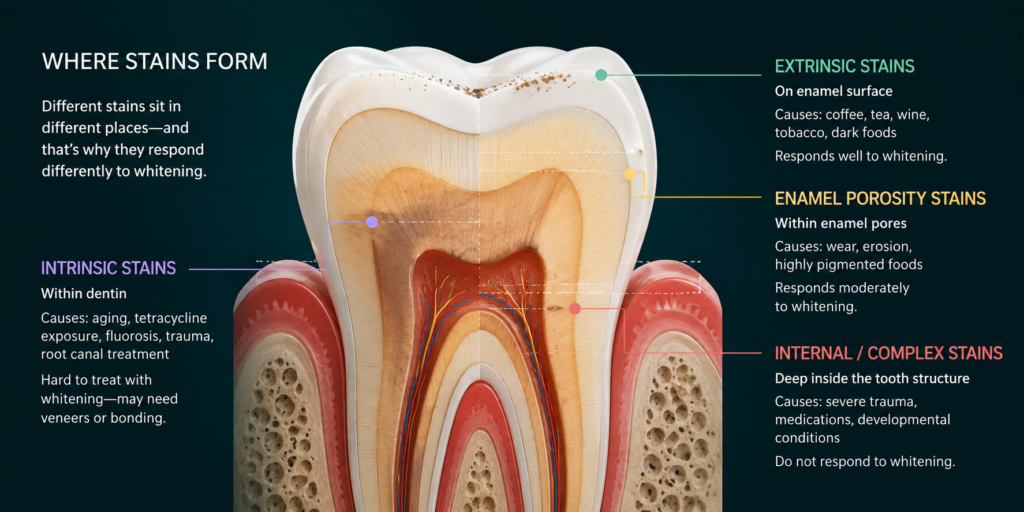
Nearly every whitening decision reduces to this. Extrinsic staining sits on the enamel and comes from what you consume — coffee, tea, red wine, tobacco, soy sauce, berries. It responds well to peroxide at almost any concentration, which is why at-home products genuinely work on it.
Intrinsic discoloration sits inside the tooth. It comes from tetracycline exposure in childhood, fluorosis, root canal treatment, aging dentine, or trauma to a specific tooth. At-home products do not meaningfully affect it. Neither, in many cases, does in-office whitening — some intrinsic staining needs veneers or bonding instead.
The rough test: evenly discolored in a yellow-brown direction usually means surface staining. Unevenly discolored with grey or banded tones usually means intrinsic. If you cannot tell, a consultation is worth the fee even if you end up whitening at home afterwards.
| If your teeth are… | Likely cause | Best route |
|---|---|---|
| Evenly yellowed, worse near the gumline | Surface staining, aging | At-home works well |
| Yellow-brown after years of coffee or tea | Surface staining | At-home works well |
| Grey or blue-grey overall | Often tetracycline | See a dentist first |
| White or brown mottled patches | Often fluorosis | See a dentist first |
| One tooth darker than the rest | Trauma or root canal | See a dentist first |
| Uneven after previous whitening | Restorations that do not whiten | See a dentist first |
Side by side
| In-office | Dentist trays | At-home kit | |
|---|---|---|---|
| Typical cost | $400–$850 | $250–$450 | $40–$90 |
| Peroxide strength | High | Medium | Low |
| Time to visible result | 1–2 visits | 2–4 weeks | 2–4 weeks |
| Shade change, typical | 4–8 shades | 3–6 shades | 2–4 shades |
| Dentist assessment | Yes | Yes | No |
| Works on intrinsic staining | Sometimes | Rarely | No |
| Sensitivity risk | Higher | Moderate | Lower |
| Result duration | 1–3 years | 1–2 years | 6–12 months |
Replace these figures with your own pricing research before launch.
Choose professional whitening if…
- Your discoloration is grey, banded, or mottled rather than evenly yellow
- One tooth is noticeably darker than its neighbours
- You have crowns, veneers, bonding, or large fillings on front teeth
- You have an event in under three weeks and need a predictable result
- You have had significant sensitivity with whitening before
- You have untreated decay, gum disease, or exposed roots
- You have tried an at-home product properly and seen no change
Choose at-home whitening if…
- Your staining is the everyday coffee, tea, wine, or aging kind
- You want to maintain results after a professional treatment
- Cost is the deciding factor and your staining is surface-level
- You are not in a rush and can commit to two to four weeks
- The nearest provider is far away or booked out
The maintenance case is the strongest argument for at-home. Paying $600 for in-office whitening and letting it fade over eighteen months, rather than spending a fraction of that keeping it, is the most common way people waste money on whitening.
About sensitivity
Whitening sensitivity is caused by peroxide reaching the dentine through the enamel. It is temporary and it is common. Higher concentration means faster results and more sensitivity, which is the main reason in-office whitening stings more than a kit.
If you have had painful whitening before, the things that help are lower-concentration gel over longer periods, shorter daily wear, a desensitizing toothpaste with potassium nitrate for two weeks beforehand, and spacing sessions further apart.
Persistent or sharp pain is not normal sensitivity and warrants a dentist’s opinion — it can indicate a crack, an exposed root, or decay.
What neither option can do
- Whiten crowns, veneers, bonding, or fillings. These stay the shade they were made. Whitening around them makes the mismatch more obvious.
- Fix tetracycline banding. Some cases improve slightly over months of supervised treatment; most need veneers.
- Make teeth “paper white”. Natural enamel has a limit, and past it you are looking at veneers, not whitening.
- Work permanently. Every result fades. Maintenance is part of the cost of either route.
If at-home is the right fit
SayCheese is our own kit, built for the surface staining described above. It will not outperform an in-office treatment and we do not claim it will. If your discoloration is on the intrinsic list, we would rather you booked a consultation than bought from us — it will not work, and a refund helps neither of us.
A two-minute quiz matches you to the right option, including telling you when a dentist is the better answer.
SayCheese is our own brand. We earn money when you buy it, and nothing when you book a dentist.
Common questions
Yes, and it is often the best value. In-office whitening for the initial lift, then a kit or trays every six to twelve months to hold it. Over five years this costs far less than repeating professional treatment, and it is what most dentists recommend anyway.
Peroxide-based whitening at consumer concentrations is well studied and generally considered safe for healthy teeth and gums when used as directed. The risks come from misuse — leaving gel on far longer than instructed, using it with untreated decay or gum disease, or using unregulated products with undisclosed concentrations. If you have any active dental problem, get it treated first.
Fewer than the marketing photos suggest, in both categories. Two to four shades is a realistic at-home outcome for surface staining; four to eight for in-office. Shade guides are not linear and lighting changes how results read, which is why before-and-after photos are unreliable across the whole industry, ours included.
For surface staining, yes, to a degree — most use the same active ingredient at a lower concentration. The trade-off is time and evenness. Strips do not conform to your teeth the way custom trays do, so results around uneven edges can be patchy.
There is not good evidence either way, so most dentists advise postponing elective whitening during pregnancy and breastfeeding as a precaution. This is a question for your dentist and your obstetric provider, not for a directory.
Prefer to see someone in person?
Find whitening providers near you, see who opens on Saturdays, and compare who is closest.